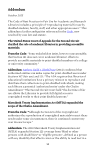
standard format, including learning disabilities and mobility
impairments. Thus, the MTIA eliminated an ambiguity concerning
the scope of Section 121.
Copyright law can address the needs of patrons with disabilities
related to media other than print.
From the Code: “No specific exception to copyright even arguably
addresses the needs of patrons with disabilities related to media
other than print.”
Addendum: It remains true that there is no specific exception in
US copyright law that explicitly allows for the creation or sharing
of accessible copies of materials such as sound recordings, motion
pictures, audiovisual works, and other non-literary works.
However, HathiTrust affirmed that libraries can rely on fair use to
justify copies made outside of the categories outlined in the Chafee
Amendment, which the MTIA expanded from “nondramatic
literary works” to “all literary works, plus musical works fixed in
the form of text or notation.” An authorized entity can rely on fair
use to create accessible versions of recorded music, videogames,
videos, and other media.
31
impairments. Thus, the MTIA eliminated an ambiguity concerning
the scope of Section 121.
Copyright law can address the needs of patrons with disabilities
related to media other than print.
From the Code: “No specific exception to copyright even arguably
addresses the needs of patrons with disabilities related to media
other than print.”
Addendum: It remains true that there is no specific exception in
US copyright law that explicitly allows for the creation or sharing
of accessible copies of materials such as sound recordings, motion
pictures, audiovisual works, and other non-literary works.
However, HathiTrust affirmed that libraries can rely on fair use to
justify copies made outside of the categories outlined in the Chafee
Amendment, which the MTIA expanded from “nondramatic
literary works” to “all literary works, plus musical works fixed in
the form of text or notation.” An authorized entity can rely on fair
use to create accessible versions of recorded music, videogames,
videos, and other media.
31